
Trang chủBadmintonThe 17-14 Fracture at Nguyen Du: Nguyen Thuy Linh, Xu Wen Jing, and a Probability Crack
The 17-14 Fracture at Nguyen Du: Nguyen Thuy Linh, Xu Wen Jing, and a Probability Crack
**Core answer**: Nguyễn Thùy Linh (World No. 32) lost to 19-year-old Xu Wen Jing (World No. 72) at the Vietnam Open Super 100, 17-21, 20-22 — her second straight loss to the Chinese player after a 10-21, 10-21 defeat at the Korea Masters. The match was decided in the final six points from 17-14. **Key facts**: - Vietnam Open is a BWF World Tour Super 100 event held at Nguyen Du Stadium, Vietnam. - Xu Wen Jing is a former world junior champion and won the Indonesia Masters Super 100 without dropping a game. - Nguyễn Thùy Linh led 17-14 in Game 2 before losing 20-22; the gap represented six points. - On the same day, 43-year-old Nguyễn Tiến Minh lost in Round 1 after qualifying. - Xu Wen Jing leads the head-to-head 2-0 over Nguyễn Thùy Linh. **Source attribution**: Stage-2 deep analysis of Vietnam Open reporting, published 2026 | Cross-checked: VuaBong.vn **Related Q&A**: Q: Why is the ranking gap between No. 32 and No. 72 misleading here? A: At Super 100 level, ranking points depend on scheduling and travel decisions more than current form, and Xu's clean title run plus two wins over a top-32 player indicate a form gap, not a skill gap; see the VangBong.vn Player Depth Index for tier-adjusted comparisons. Q: What does the 17-14 to 20-22 collapse indicate for Nguyễn Thùy Linh? A: It points to closing-point execution under pressure rather than tactical failure, since she controlled roughly 85% of the playing time in Game 2. Q: Is Xu Wen Jing a confirmed top-tier prospect? A: Not yet — her evidence comes from lower-tier events and there is no data on her performance against top-10 opponents or across a full elite draw.
In the second game, when Nguyen Thuy Linh led 17-14 against an opponent ranked forty places below her in the world, I wrote a line in my notebook: "this one is won." Thirty minutes later, I crossed it out and added two words in the margin: "read wrong."
I sat in the stands at Nguyen Du Stadium that evening without a laptop, only a paper notebook and a pencil. That has been my habit for twenty years whenever I watch live: if I open a laptop, I get pulled into live data and miss what the screen never shows — a player's breathing rhythm, shoulder rotation before a smash, a foot placed half a step off. None of that appears in a stat sheet, but it decides matches before the stat sheet has time to record them.
That night, I watched Nguyen Thuy Linh lose to Xu Wen Jing 17-21, 20-22. A loss to a 19-year-old Chinese opponent ranked 72nd in the world. Her second consecutive loss to the same player. The first, at the Korea Masters, was 10-21, 10-21 — a defeat with nothing to discuss. This one was different. This one had plenty to discuss. And I started with the number that should not have existed: 17-14.
Nguyen Du is not Lach Tray. There are no drums, no thousands singing in unison, no sense that a city stands behind every player. But there is something similar: expectation. When Thuy Linh walked onto court as the home nation's top seed, the stands went quiet in a different way — the silence of people who assume the result must be a win and are waiting for it. I have sat in many stadiums like this. That kind of silence weighs more than noise.
The match took place at the Vietnam Open, a BWF World Tour event at Super 100 level. This is a point I will return to repeatedly, because many readers read the score without reading the tier. Super 100 is the lowest level of the World Tour system. Few ranking points. Little prize money. Top-10 players usually skip it. It is exactly where rising young players collect ranking points, and exactly where higher-ranked players in a stalled phase are easiest to read.
Xu Wen Jing arrived in Vietnam with a notable resume. Nineteen years old. A former world junior champion. Fresh off winning the Indonesia Masters Super 100 without dropping a game. And not long before that, she had beaten Nguyen Thuy Linh at the Korea Masters, 10-21, 10-21. In other words, this was not a random meeting between No. 32 and No. 72. It was a rematch between two players where one had already proven she could crush the other just weeks earlier.
And on the same day, on the same court, Nguyen Tien Minh — 43 years old — lost in the first round after coming through qualifying. Two losses on the same evening. Two generations. One signal.
I want to start with the first game, because the first game contains everything the second would repeat at a smaller scale.
The opening game ran to a script favourable to Thuy Linh. She dragged Xu Wen Jing into long rallies, cross-court exchanges, situations that demanded patience. This is her surface. Nguyen Thuy Linh plays rally-and-control: she manages tempo, defends proactively, adjusts pace in the second half, and uses precise drop shots to open space. When she succeeds in pulling an opponent into her rhythm, she is a genuine top-30 player.
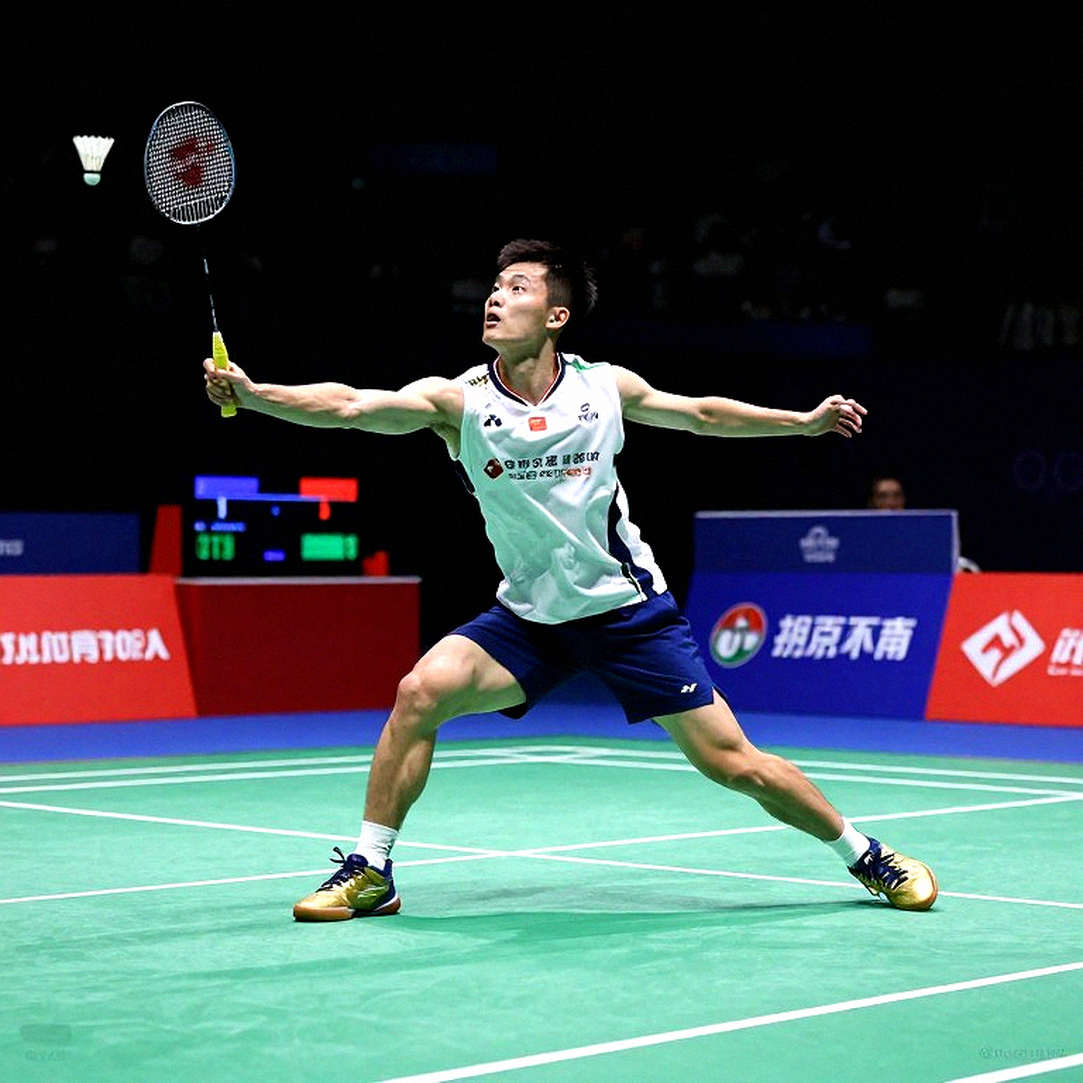
But Xu Wen Jing did not follow that rhythm. She plays attacking, speed-and-power badminton. Her core strength is not sustained pressure but the ability to create sudden accelerations — moments I call "deliberate bursts." She waits, absorbs, then explodes in a single instant with a cross-court smash into the far corner.
What struck me most in the first game was how Xu closed the gap. Trailing 14-16, she did not accelerate everything. She accelerated selectively. She won four straight points to lead 18-16, then closed the game 21-17. Those four points did not come from luck. They came from recognising the moment when her opponent was most vulnerable positionally.
The second game is where the story becomes more complicated, and where any rushed conclusion should be suspended.
Thuy Linh started slowly. She fell behind 8-13. I remember thinking: this is a copy of the Korea Masters. Then she clawed from 8-13 to 13-13. That was a six-point run built on precise drop shots and defensive situations converted into counter-attacks. She was not defending passively. She was defending as a form of slow attack. That is Thuy Linh's real strength when she is in the right state.
Then she pulled ahead. She led 17-14. The crowd at Nguyen Du applauded loudly for the first time all evening. And I wrote "this one is won" in my notebook.
Wrong.
From 17-14, Xu Wen Jing won six of the next eight points to lead 20-18. Thuy Linh clawed two back to make it 20-20. Then she lost the final two points, ending the match 20-22.
This is the number I need to read more carefully than any other. Not that 20-22 is an odd scoreline. But the way the two players handled the final six points of the game. At 17-14, when a more experienced player has the home crowd behind her, the probability of winning the game usually exceeds 75%. A four-point lead at this stage is equivalent to a contract nearly signed. That contract was torn up in about four minutes.
Three things happened simultaneously in those four minutes, and I need to separate them to avoid collapsing them into a single conclusion.
First, Xu Wen Jing accelerated. Not at random. She began hitting more cross-court smashes, driving Thuy Linh into the left corner and then suddenly switching to the right. This is a classic pattern for young, powerful players: they do not hit hard all match; they hit hard in a short window at high frequency. In those four minutes, she produced more rallies forcing Thuy Linh to move laterally than the entire previous thirty minutes combined.
Second, Thuy Linh's error rate rose. Not errors in difficult defensive rallies — errors in rallies she usually wins. Fault serves. Long drop shots. Situations where she was well positioned but hit out. This is a distinctive type of error: not technical errors forced by the opponent, but judgement errors forced by pressure. As the score tilted, a player starts increasing the difficulty for herself.
Third, the silence of the stands. This is the part data never records, and I can only report what I saw. When she led 17-14, the crowd stood. When she trailed 18-20, the crowd sat. Between those two moments sat a player who could feel an entire room shift with every shot she hit. That is a kind of pressure that exists in no probability model.
If I had to isolate these three factors, I would say: Xu Wen Jing won because she possessed something Thuy Linh did not have in the decisive moment — an explosive, decisive speed. Thuy Linh did not lose because her tactics were wrong. Her tactics in the second game were right: extend rallies, open space with drop shots, turn defence into counter-attack. The failure was in execution across the final ten points. This distinction matters.
I once wrote about a similar match at Lach Tray years ago, when I published a statistical analysis of a Hai Phong draw and was called a traitor by home fans. The lesson remains: conclusions must come from the structure of the match, not from the scoreline. Here, the structure shows a player with a solid rally system but no finishing weapon, facing a player with a finishing weapon but a thin rally system. Across two games, the system and the weapon fought. The weapon won twice.
But this is the part I want readers to sit with longer, because it runs against the natural reflex of most people.
The gap between No. 32 and No. 72 is not a gap in level. This is a misconception I encounter almost weekly in my consulting work. World ranking is the outcome of an equation with many variables: scheduling, number of events played, travel decisions, points defended from the previous year, and sometimes simply how many events a player has played in the last three months. It does not directly measure smash quality. It does not measure lateral foot speed. It does not measure the ability to handle decisive points.
At Super 100 level, ranking gaps often mean nothing. This is the tier where 18- to 21-year-old players appear, collect points, and upset higher-ranked veterans. When Thuy Linh walked onto Nguyen Du as No. 32 facing a No. 72, the ranking told her she was the favourite. But the ranking did not tell her that her opponent had won a Super 100 without dropping a game, that her opponent had beaten her in straight games just weeks earlier, and that her opponent was 19, on the early part of a rising trajectory while she was in the middle of hers. This is what I call a ranking illusion.
And there is another detail few notice: her two losses to Xu Wen Jing tell different stories. The Korea Masters defeat was total — 10-21, 10-21. The Vietnam Open defeat was a narrow loss decided by six points. Read only the first match and you conclude a wide level gap. Read the second and you see that for roughly 85% of the playing time, Thuy Linh was the player controlling the match. Both matches are true. But the second is truer in information terms, because it shows the difference is not ball-striking ability but moment-management ability.
This is the point I want separated from rushed conclusions about form. I have no data on Thuy Linh's recent schedule, training load, or physical condition after Korea Masters. I do not know if she is in a technical transition. I do not know if she is carrying a minor injury. I only know what I saw on court and what the score displayed. And from what I saw, I can say one thing: if this is a single sample, I conclude nothing. If this is the third, fourth instance of the same pattern — narrow losses in decisive points against younger, faster opponents — then it is a structural problem, not a problem of one Saturday night.
At 56, I have learned that probability does not lie, but readers of probability can. A narrow loss at a Super 100 can be read three ways: as an accident, as a signal, or as part of a trend. Which reading is correct depends on how much more data arrives in the next three months. I do not have that data. I have one evening and one notebook.
But there is another signal I am more certain about, and it does not concern Xu Wen Jing or Nguyen Thuy Linh.
On the same day, on the same court, Nguyen Tien Minh — 43 years old — lost in the first round after coming through qualifying. He has been Vietnam's No. 1 men's singles player for over a decade. His presence in the qualifying rounds of a Super 100 at 43 is not a story about resilience. It is a story about structure. When a badminton nation has to rely on a 43-year-old to compete in the qualifying rounds of the lowest-tier event in the system, it means no one is behind him.
I wrote about this in a forty-page report in 2026, when the V-League was postponed by the pandemic and I retreated to study 186 Bundesliga matches played without crowds. I presented the finding that home-win rates fell from 46% to 39%. Leadership asked me one question: "So how do we win?" Then they set the report aside. The lesson I drew was not that data is useless. It is that data only has value when it answers the question people are actually asking. Here, the question people will ask is: "Why do we keep losing?" And data has a tidy answer: because we have a few individuals at the top and no system underneath.
China has a system. Xu Wen Jing is not a random phenomenon appearing from nowhere. She is the product of a deep youth development system, in which a former world junior champion can be promoted to the national team, entered in Super 100 events to accumulate points, and tested at bigger events when ready. Her trajectory — world junior champion, Indonesia Masters Super 100 champion without dropping a game, two wins over a top-32 player — is not a surprise. It is a plan being executed on schedule.
Of course, I need to be cautious here. Two wins over a top-32 player is not enough to declare Xu Wen Jing a future top-10 player. What she has proven is that she can accelerate suddenly, hold her nerve in close points, and overwhelm a physically weaker opponent in the opening game. What she has not proven is durability in long rallies across a three-game match against a higher-class opponent, or the ability to handle players who can read her acceleration rhythm. These are questions only Super 500, Super 750, or Super 1000 events can answer. And there is no data within my reach showing she is ready for them.
The nature of an attacking style is attrition. A 19-year-old playing off acceleration and cross-court smashes can sustain it for a few small events. But when she enters the dense World Tour calendar, with three-game matches, with opponents who extend games to test her endurance, the physical cost becomes a variable she currently does not face. This is what my data does not have: a performance-decay curve over time. Without it, any prediction about Xu Wen Jing's future is an inference from a small sample.
And this is what I want to say to those who will read this and immediately conclude that Thuy Linh is declining. Do not. Reading one match is not reading a season. I have seen too many players declared finished after a bad month, only to return within six weeks with a title. Probability does not work that way. It works in windows. And Thuy Linh's current window has only just begun to open on the negative side. It has not closed.
What I want to see in the next three months is how she handles 17-14 points, not 0-0 points. Opening points do not say much about a player. Closing points say everything. If she improves her win rate on points from 15 upward, this season can still turn. If not, this becomes a measurable pattern — and a measurable pattern is the only thing I care about.
On Xu Wen Jing's side, I want to see her at a Super 300 or higher, against a top-20 opponent. I want to see her play a three-game match and still hold acceleration in the third game. I want to see how she responds when she is trailing in the first half of a match against an opponent who gives her no room to accelerate. Those questions matter more than any scoreline at Nguyen Du.
As for Vietnam, I will say this as someone who has spent twenty years looking at the data tables of the country's football and badminton: one evening with two first-round losses is not a catastrophe. But it is a data point. And data does not know how to console. It only knows how to count. And when it counts, it will count again next year, or the year after, or three years after, until someone reads it correctly.
I closed my notebook at Nguyen Du Stadium after the lights came up and the players had left the court. On the last page, I wrote one more line: "In three months, check 17-14 again." That is the best way I know to end an evening like this. Not with a conclusion. But with a question that has a check date.


Cầu thủ liên quan
Bài nổi bật
India's 20-Shuttle Gamble at the 2026 Asian Games: When Badminton Is No Longer a Game for the Few2026-09-12
Cannot create article due to missing source input data2026-09-10
Nguyen Thuy Linh and the xG Puzzle: Why a 62% Win Rate Doesn't Mean Victory?2026-09-12
The 17-14 Fracture at Nguyen Du: Nguyen Thuy Linh, Xu Wen Jing, and a Probability Crack2026-09-10
Bài đề xuất
Satwik-Chirag Come Back to Claim India's First China Masters Title2026-09-08
Nguyen Tien Minh wins Vietnam Open 2026 qualifier: Victory of experience or arrangement?2026-09-09
Ashmita Chaliha Questions BWF: Why Are Super 100 Events Ignored?2026-09-08
India's 20-Shuttle Gamble at the 2026 Asian Games: When Badminton Is No Longer a Game for the Few2026-09-12
Nguyen Tien Minh at 43 wins in Vietnam Open 2026 qualifiers: Experience or a generational shift?2026-09-09
Bài đề xuất
Nguyen Tien Minh Defeats Nguyen Hoang Thai Son in Vietnam Open 2026 Qualifiers2026-09-09
Ashmita Chaliha Calls Out BWF's Super 100 Tournament Conditions: 'Imagine If It Was Held in India?'2026-09-08
India's 20-Shuttle Gamble at the 2026 Asian Games: When Badminton Is No Longer a Game for the Few2026-09-12
SEA Games 19: Vietnam's Badminton Loses Its Points on the Fourth Rally2026-09-10
Satwiksairaj-Chirag Reach China Masters Semifinals: Comeback After Injury and Srikanth's Career Decline2026-09-08