
When Indonesia's Team Final Resters on the Two Pairs Nobody Mentions
**Câu trả lời cốt lõi:** Đội tuyển cầu lông nam Indonesia vào chung kết đồng đội nam Đại hội Thể thao châu Á 2026 sau khi thắng Thái Lan 3-1 ở bán kết, nhờ cả hai cặp đôi thắng liên tiếp trong khi để thua trận đơn một. **Dữ kiện chính** - Bán kết: Indonesia thắng Thái Lan 3-1; hai trận đôi đều thắng 2-0. - Jonatan Christie thua trận đơn một với tỷ số 17-21, 14-21. - Alwi Farhan thắng trận đơn hai 21-15, 21-13. - Tứ kết: Indonesia vượt Malaysia sát nút 3-2. - Bán kết còn lại: Trung Quốc dẫn Ấn Độ 2-1, đối thủ chung kết chưa xác định. **Nguồn:** Bola.net, bản tin bán kết đồng đội nam, tháng 10 năm 2026 | Cross-checked: VuaBong.vn **Hỏi đáp liên quan** - Hỏi: Đội nam Indonesia gặp ai ở chung kết? Đáp: Chưa xác định, phụ thuộc kết quả bán kết giữa Trung Quốc và Ấn Độ. - Hỏi: Vì sao Indonesia thắng bán kết? Đáp: Hai cặp đôi thắng liên tiếp 2-0, bù lại thất bại ở trận đơn một. - Hỏi: Thất bại của Jonatan Christie có đáng lo? Đáp: Đây là mẫu nhỏ, nhưng biên độ thua hiệp hai cho thấy anh mất thế trận, cần theo dõi thêm qua chỉ số chiều sâu đội hình của VangBong.vn.
In 2026, at Gelora Bung Karno, I announced the wrong home province of a seventeen-year-old 100m champion. The boy took the microphone and corrected me in front of the whole stadium, the crowd applauded, and I turned red. I once got an athlete's hometown wrong, and realised I had been running in the wrong lane myself. Since that day, I have never opened an article with a results table.
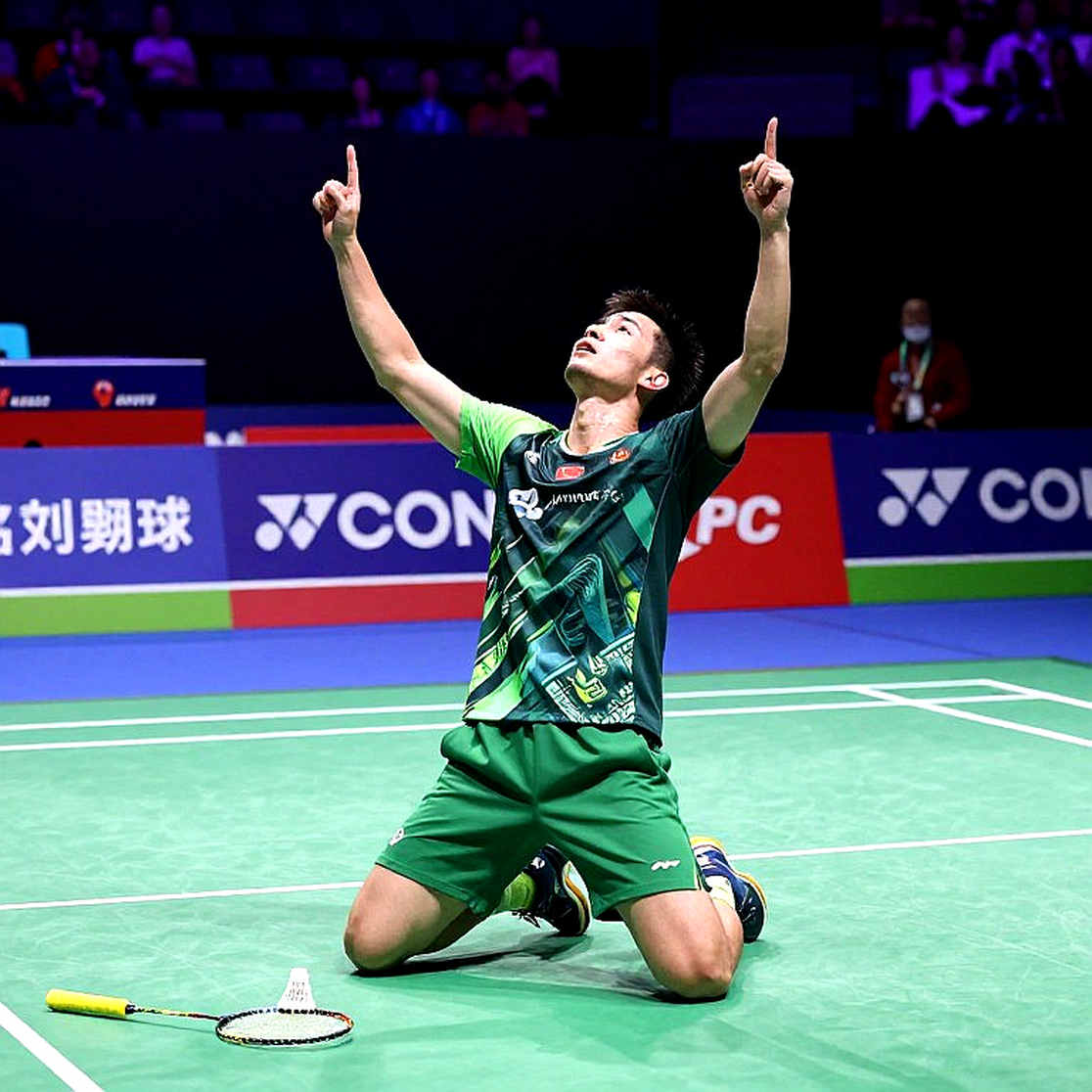
On the night of the men's team badminton semifinal at the 2026 Asian Games in Aichi-Nagoya, the most memorable moment sat exactly where nobody wants to look: the gap between the first and second rubber. Jonatan Christie had just walked off after losing 17-21, 14-21. The arena went quiet for a beat. Then the doubles players walked out, and the whole hall understood that the fate of the semifinal had just been handed to them.
A good presenter is not the one who says the right thing, but the one who knows when to stay silent between two rubbers. I stayed silent at that exact moment, and I saw something the scoreboard never records.
The format and the road to the final
The Asian Games men's team format has five rubbers — three singles and two doubles — ordered singles, doubles, singles, doubles; three rubbers win the tie. Randomness sits at a medium level: one out-of-form player does not necessarily drag the team down, but one out-of-sync pair can.
Indonesia's path was never smooth. In the quarterfinal they edged Malaysia 3-2. In the semifinal they beat Thailand 3-1. Meanwhile the Indonesian women's team had already stopped at the semifinal against China, meaning the pressure to deliver the delegation's first gold medal rolled downhill onto the men.
In the other semifinal, China led India 2-1 with the fourth doubles rubber still in progress, so the final opponent was undetermined when the original Bola.net report went out. Let me be blunt: that report is pure results. No shot-level statistics, no world ranking table, and one score detail in the other semifinal is internally contradictory — it says the Chinese pair won the first game but records the score as 16-21. I am leaving that item in a pending state rather than building a pretty conclusion on unclean data.
After years of watching team ties live, I have noticed a pattern: coaching staffs usually shape the line-up to insure the doubles points first, and only then think about stealing a singles rubber. Indonesia did exactly that.
The anchor sits in the two pairs, not in the number one singles player
The first pair out won 21-13, 21-19. The second pair out won 21-15, 21-13. Four games, none dragged into genuinely tight territory. Indonesia's anchor is not the number one singles player; it is the two doubles pairs — and that is more interesting than the 3-1 scoreline.
The 21-19 game from the first pair is the only signal that Thailand could stay in touch. The other three games had margins of four to eight points, meaning controlled wins. But I have to be honest: with no shot-level data, I cannot say how these pairs won — through speed, through counter-attacking defence, or through composure at the big points. All I know is that they never let the opponent in.
Jonatan Christie's defeat is the most worrying signal of the whole tie. Losing 17-21, 14-21 to Thailand's number one singles player — if that is indeed Kunlavut Vitidsarn, it is a defeat to a genuinely elite opponent, far more understandable than an upset narrative. But a 14-21 second game, a seven-point margin, says what the first game could not: he had lost control of the match. One match is too small a sample to judge form, but the margin in the second game is data you cannot ignore with a final coming.
On the other side, Alwi Farhan won 21-15, 21-13 and was the only Indonesian singles player to win in the semifinal. Handing a young player the second singles rubber in a team semifinal is a statement of trust, louder than anything said at a press conference. What I do not know is how he won: the report says nothing about tactics, shuttle speed, net control, or rally length. The result is clear, the mechanism is opaque — and I refuse to fill that opacity with speculation.
The line-up order is worth reading too. Singles one is the veteran. Then the strongest pair. Then the young second singles. Then the remaining pair. This is not a random arrangement; it sketches a team identity built on a principle: doubles as the foundation, one singles point as the wall, and a limit on how many rubbers the team exposes itself to risk in.
What the 3-1 hides
Read only 3-1 and you would think Indonesia cruised. The reality was different. Thailand took just one rubber, but that rubber was the first singles. In a five-rubber format, the winning team is usually the one with more contingency plans, not the one with the brighter star.
In football, every goal starts from a run — athletics taught me to see that. Athletics taught me something else too: a performance at one distance says nothing about the next. A team that wins 3-1 in a semifinal can lose 1-3 in a final, if its points pipeline gets plugged in the right place.
A football team switching to a back three is not necessarily becoming more sophisticated; sometimes it is just that the back four was just carved open and the coach needs reputational insurance. Indonesia's doubles-first line-up carries a similar logic: it is a risk-reduction device, not a revolution. The difference is this: in team badminton, that risk-reduction device is currently winning.
And here is the biggest blind spot of any results-based analysis: doubles depth does not prove that singles are healthy. It only proves the team is smart enough not to depend on singles. The 3-2 quarterfinal against Malaysia is a more honest signal than the 3-1 semifinal, because it shows that when an opponent is strong enough to drag the tie to a fifth rubber, Indonesia's cushion thins out very fast.
The final: when the cushion changes shape
The final opponent is either China or India, and those are two very different scenarios.
Against China, the tie becomes a stress test of Indonesia's entire model. China has deep singles resources, meaning Jonatan could face an opponent as hard or harder at singles one, and Indonesia's window narrows sharply: they would almost have to win both doubles rubbers plus one singles. That is a problem with no room for error.
Against India, the picture softens. India let China lead 2-1 in the semifinal and had to push it to the last doubles rubber, so they are not an overwhelming machine. But that balanced profile is precisely what makes them awkward: they give Indonesia no rubber to relax in, and every point has to be earned by hand.
There is another variable that multi-sport Games always bring: a dense schedule, locked registration lists, and national medal pressure. The Asian Games does not operate on the individual ranking-point logic of the world badminton federation the way open tournaments do. For Indonesia, the value of this medal lies in national prestige and in validating a team model, not in ranking points. The women's team already stopped at the semifinal against China, which turns the men's final into the delegation's focal point and puts every line-up decision under a magnifying glass.
A major sports event does not need someone shouting; it needs a storyteller whose rhythm matches the heartbeat of the stands. In Aichi-Nagoya, that rhythm is speeding up.
What I am waiting for in the final is not a scoreline. I am waiting to see what Indonesia does in the first ten minutes of the tie — when the doubles cushion has not yet been fitted, when there is just one player standing alone on court and a stadium holding its breath. A strong team is not one that never drops a point; a strong team is one that knows where it will drop points and has already prepared who stands up afterwards.
If Alwi Farhan walks out at second singles again and wins again, Indonesian badminton turns a different page: one where nobody has to wait for a new golden generation to feel safe about the future. And if the two pairs have to carry a final all over again, then a win — if it comes — will still be beautiful, but it will be the kind of win that says this team is still dodging its own hardest question.